Sunday, March 20, 2011

The Cross and the Switchblade


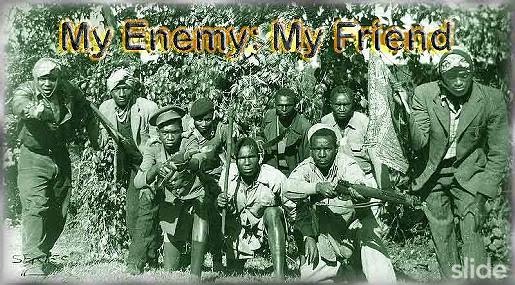
Politicians like Sarah Palin, and the Tea Party movement she represents, are a desperate rear-guard action against demographic and cultural changes that they refuse to accept. On the fringes of this movement are the white supremacists, neo-Nazis, etc. who are at least honest about who and what they hate. The mainstream of the movement will vehemently deny that their opposition to Obama, and what he represents, is in any way motivated by his skin color. That claim is quickly demolished by even a cursory examination of their preferred means of attacking the president. The continuing "controversy" about Obama's birth certificate strikes at his very legitimacy as an American citizen. The message is unmistakable: "He is not one of us.". Can anyone imagine a white president being treated in such a fashion? It is simply inconceivable. The nonsense about Obama's father and grandfather and Kenyan Mau Mau rebels fighting the British is an even more blatant use of race. What on earth could any of that have to do with anything? Unless it's a not-so-subtle way of attempting to link Obama with some very scary-sounding Africans, who probably slaughtered a lot of white people.

Friday, March 18, 2011

What's in a Name?

Facebook has this new feature called "Notes" that allows users to write far beyond the 160 character limit that applies to status posts. So, instead of writing a blog post and linking to it through facebook, I decided to do the opposite. Here it is...

Thursday, March 3, 2011

El Judio Maravilloso


We can only speculate on what Cuba would look like today had the Revolution not taken place. Would it have become the Mob-controlled City-State envisioned, and largely realized, by American organized crime figures such as Meyer Lansky? Impossible to say with any degree of certainty, but is surely a provocative question. In the book Havana Nocturne by the author T.J. English, the full extent of the Mob's control of Havana's decadent entertainment industry is revealed. And, with the "benevolent" Cuban dictator Fulgencio Batista as their partner, the sky really did seem to be the limit.

T.J. English manages to accomplish the remarkable feat of making this reader feel nostalgic for the world that Castro obliterated when he came down from the mountains. Havana Nocturne brings that world to vivid, colorful life and what a story it is. The protagonist of the book is clearly the Jewish-American mobster Meyer Lansky, who is the driving force behind the Mob's colonization of Cuba. Lansky stood at the pinnacle of success in 1958 having achieved his dreams of creating an off-shore criminal empire that was beyond the reach of American law enforcement. In 1958 Havana a perfect nexus of crime, show business, and politics existed to a degree impossible to realize in the United States.

The book is chock-full of fascinating characters and events. I never knew that when Desi Arnez would cry out "Babalu" as he was banging on his bongo drum, he was actually invoking the Santeria God of percussion. The wildly popular 1950's sitcom I Love Lucy, which featured the Cuban-American musician Arnez and his wife actress Lucille Ball, exposed American television audiences to Cuban music and dance culture.

In today's wired and digital world, a book need not be a stand-alone experience. A taste of the sights and sounds of 1950's Havana was as close as a youtube search. This video I'm embedding serves as a splendid companion to a book which I highly recommend...


Thursday, February 17, 2011

Whistling Dixie


As we move further into the sesquicentennial anniversary year of the American Civil War, there are quite a few interesting things to consider. The New York Times has been running their Disunion series for a number of weeks now and it is truly fascinating. Even USA TODAY, which I tend not to read unless stuck in an airport, weighed in with a very good look at the subject. The Secession Ball was a not-to-miss event if you happened to be Charleston, SC. Maybe in four more years, they'll burn down the city again!

On a more scholarly note, I happen to be reading a book right now titled How We Fight: Crusades, Quagmires, and the American Way of War by Dominic Tierney. Haven't finished it yet, but did get through the chapter that is relevant to this post. Tierney picks the Civil War as his starting point, and does an excellent job of analyzing the glaring difference between how the war was fought, and the way in which the peace was lost. Meaning that the Union was infused with a powerful crusading spirit so long as the fighting was continuing, but the people of the North did not have the will or the patience to see the project through to the end.

The Reconstruction period that followed the end of hostilities is barely remembered today. If it is remembered, the perception is of a failed experiment marked by "scalawags", "carpetbaggers", and rampant corruption. While elements of all these things did exist, that is not quite the entire story. Dominic Tierney offers a novel treatment of the Reconstruction era. Tierney presents it as America's first attempt at what we today call "nation-building". And that is an excellent way to describe Reconstruction.

In April of 1865, the South lay largely in ruins. The region's entire social structure had been completely upended. It's economy and physical infrastructure was wrecked. Never was there a more opportune time for the victors to go about reordering the system, and rebuilding the South in their own image. Unfortunately, Abraham Lincoln was murdered and his vice-president Andrew Johnson was not the man to impose such a peace. When Grant took office, progress was finally being made, but precious time had been lost.

What followed was a sad litany of Southern white resistance, puncuated by acts of extreme terrorism, aimed at returning blacks to their former status. The people of the North eventually tired of the whole dismal enterprise and the last federal troops were removed from the region in 1877. Blacks ended up waiting another century to finally receive the whole range of rights guaranteed them by the Constitution.

Dominic Tierney poses a very provocative question towards the end of the chapter. He asks how much worse could the Reconstruction government have been then the one that led the region into a catastrophic war in 1861?


Tuesday, February 8, 2011

Lunatic Fringe

When the process of governing is incomprehensible, manipulation and propaganda thrives. The strange stories that Glenn Beck creates with his chalkboard gain traction with Americans, who are made anxious by the large changes that have overtaken the United States, including the election of a black president and the increasing racial diversity of the population, deindustrialisation and the decline of American power abroad, as well as cultural changes in sexual and family norms.

By telling simple fairy tales that trace these big and complex changes to the machinations of particular people, Beck makes the changes comprehensible in a way, and also makes the people who are presumably responsible the targets of his listeners' frustration and outrage. Partly because it is utterly irrational, and partly because it is an effort to bully and intimidate his political opponents, this is dangerous for democratic politics.


The above paragraphs were written by Francis Fox Piven, an elderly academic who has become the latest target of Glenn Beck's increasingly unhinged rhetoric. Despite being subjected to numerous death threats, as a result of the spotlight Beck is putting her in, Piven has managed to maintain her composure, while providing the most lucid explanation of Beck's appeal that I have yet heard. Anyone with even a rudimentary understanding of 20th century history should quickly recognize Beck's "history lessons" for what they are. Glenn Beck starts with an already formulated version of history complete with stock villains. He then proceeds to distort the historical record until it fits his warped version of events.


Another person who makes sense of otherwise seemingly inexplicable political and cultural phenomenon is Chris Hedges, a columnist and foreign correspondent. Hedges most recent book is titled Death of the Liberal Class, and I am about halfway through it at the moment. A discussion about the book by the author is available on youtube, and is definitely worth a watch. Interestingly enough, Hedges works within the same time period in American history as does Beck, but without the chalkboard, tweed jacket, pipe, or insane theories.


Since I can embed the video within my blog post, I think I'm going to do just that:


Monday, January 24, 2011

From My Cold Dead Hands


The temptation to try and turn the shooting of Gabrielle Giffords into a feel-good narrative appears to have won out. Rather then use the horrific event as an opportunity to honestly examine the consequences of our fatal attraction to firearms, the focus has already shifted to daily updates about the congresswoman's progress. Incremental signs of improvement are eagerly seized upon and presented as evidence of a "miraculous" recovery. And while some of that enthusiasm is tempered with reminders of just how difficult a journey lies ahead for Giffords, the desired story line has already been established.

The other 18 people shot have been effectively marginalized, for the most part. The living, and the dead, will recede from our collective memory, and the Tucson shooting will be reduced to the story of two individuals: the gunman and his primary target. Jared Lee Loughner will be portrayed as an aberration, rather then a particular type that is all too familiar to us. Gabby Gifford has already been reduced to a symbol of "healing", both literally and metaphorically, instead of the vibrant and intelligent human being that existed before a bullet tore through her brain.

Friday, December 3, 2010

"Black People should buy rifles and join the NRA"

"They were the Bad Niggers of white America's nightmares come chillingly to life - a black-bereted, black-jacketed cadre of street bloods risen up in arms against the established order."

With that sentence, Newsweek Magazine opened it's February 23, 1970 cover story about the Black Panther Party. Note the past tense used by the writers because it was no accident. At the beginning of 1970, the Panthers were struggling just to survive. Nixon's Justice Department had declared them to be a menace to national security, and Hoover's FBI had successfully executed a counter-intelligence operation against the Panthers, one that had turned it's members against one another. On top of that, law enforcement officials at the local level had been waging war against the Panthers, almost since the Party's inception in 1966.

As of the publication date of the magazine, the Party's top leadership had been effectively neutralized: Huey Newton was in prison charged with killing a cop; Eldridge Cleaver was a fugitive in Algiers along with his wife, Kathleen; Bobby Seale was in jail in San Francisco, awaiting extradition to Connecticut. Meanwhile, local chapters across the country were being decimated by police raids and resultant gun battles. Police viewed the Black Panthers as mortal enemies and proceed accordingly. The Panther's fiery rhetoric, which frequently referred to cops as "pigs" and "motherfuckers", did little to ease tensions between the two groups.

In a remarkable echo of today's headlines, 22 Panthers were charged with conspiring to dynamite Macy's and four other stores, the New York Botanical Garden, the New Haven Railroad tracks and four New York City police stations. It appears that there was some coordination between the Panthers and the Weather Underground during this time. Today, 40 years later, we know just how thoroughly the ranks of the Panthers had been infiltrated by law enforcement. In fact, one wonders if the push to desegregate police departments, during the 1960's, might not have had a less then noble purpose. Meaning that black cops were needed to infiltrate the Party, and there were precious few to be found at first.

One can't help but wonder how many lives might have been spared if the collective power of American law enforcement had been similarly mobilized against the KKK. Conservatives are constantly invoking the heinous deeds committed by the likes of Bill Ayers and other leftist groups, including the Black Panthers, but are strangely silent when it comes to the Klan. It is almost as if "Bombingham" never existed. Blowhards like Rush Limbaugh and his ilk thunder on about the New Black Panther Party and alleged intimidation of voters at the polling places, but you hear not a word about the systematic disenfranchisement of tens of thousands of voters because of felony convictions. That those state laws, unevenly and inconsistently applied, disproportionately effect African-American voters is beyond dispute.